

- Save |
- Email |
- RSS |
- Newsletter
You have saved this page | See all saved pages
Upcoming Models
-
2012 Porsche Cayman MSRP not available for Pre-Production vehicles
 View photos
New Models
-
2011 Porsche Cayman MSRP from $51,900
View photos
-
2011 Porsche Cayman R MSRP from $66,300
View photos
Used Models
-
2010 Porsche Cayman Used TMV from $45,587 Find Used Inventory
View photos
-
2009 Porsche Cayman Used TMV from $39,360 Find Used Inventory
View photos
-
2008 Porsche Cayman Used TMV from $32,682 Find Used Inventory
View photos
-
2007 Porsche Cayman Used TMV from $28,465 Find Used Inventory
View photos
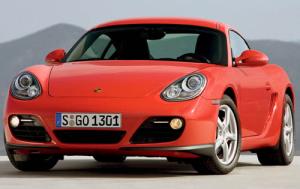
Ever since Porsche introduced the midengine Boxster as a return to the "affordable" Porsche, enthusiasts have been clamoring for a hardtop version. The argument was that a version with a proper roof would be more rigid, less expensive, lighter and a better performer than a convertible. Pleas were finally answered with the 2006 debut of the Porsche Cayman. Based on the second-generation Boxster, the Cayman coupe (whose name is said to reference an alligator indigenous to Central and South America) shares much of its mechanical midengine underpinnings with its drop-top sibling. However, it does wear unique and very attractive sheet metal.
The Porsche Cayman combines sublime handling abilities, brakes that beg to be pushed hot into a corner and a choice of two engines that will enthusiastically sing as they slingshot you down the straightaway. Some of our editors who have driven the Cayman extensively report that its well-balanced chassis could actually handle considerably more power, and it's suspected that Porsche limited the Cayman's capabilities as not to overlap with its seminal 911.
If there's a complaint, it's that the Cayman is priced considerably more than its competitors, especially when a host of desirable options are selected. But when it comes to providing a combination of all-around performance, sublime driver interaction, day-to-day comfort and desirable prestige, we can't think of a better car in this segment than the Cayman.
Current Porsche Cayman
The midengine Porsche Cayman is offered in two models, the base Cayman and the Cayman S. The base Cayman is powered by a 2.9-liter six-cylinder boxer engine that produces 265 horsepower and 221 pound-feet of torque. Step up to the Cayman S and the engine expands to 3.4 liters and power grows to 320 hp and 273 lb-ft of torque. Standard on both models is a six-speed manual, with Porsche's seven-speed dual-clutch automated manual (named PDK) optional. This transmission is capable of operating in full automatic mode or with gearchanges ordered up by the driver via wheel-mounted buttons. Regardless of which mode you use, shifts are incredibly quick and smooth. PDK also produces better acceleration and fuel economy.
When it comes to the suspension, the Porsche Cayman takes advantage of its stiffer-than-a-convertible structure by offering a level of handling and nimbleness that is a step above the capabilities of the Boxster. Safety aids include antilock brakes, traction control and stability control, all tuned to intervene only when absolutely necessary so as not to detract from the sporting nature of the Cayman. Optional is Porsche Active Suspension Management (PASM) which, via a variety of sensors, electronically and automatically adjusts the suspension to optimize either comfort or handling, depending on the setting and the driver's level of aggression. Larger wheels and tires round out the suspension options and help to improve braking. Braking performance is further enhanced on the Cayman S by optional carbon-ceramic brakes.
The interior accommodations take their cue from the Boxster and offer the typical Porsche combination of sport and luxury, with leather and metallic accents decorating the cabin. The leather-appointed seats possess the ability to both hold the driver in place during spirited maneuvers and to coddle driver and passenger during more serene outings. High-end audio and navigation are available on both Cayman models, though the base stereo offerings are disappointing for a car in this price range. Cargo room is generous for such a small and sporting vehicle, as the midengine layout allows for both fore and aft cargo areas that together equal the trunk space of a midsize family sedan.
Used Porsche Cayman Models
The Porsche Cayman debuted in the 2006 model year. For the first year, only the Cayman S model was available. Like the current model, it was powered by a 3.4-liter boxer six-cylinder, but it produced 295 hp and 250 lb-ft of torque. The base Cayman model launched for 2007 and featured a 2.7-liter six-cylinder with 245 hp and 201 lb-ft of torque. Its standard manual transmission featured five gears, while both models' optional automatic transmission was a more traditional five-speed unit with "Tiptronic" manual control.
Prior to the 2009 refresh, the optional navigation system was an older design with a smaller screen and poorly designed controls. Items like ventilated seats, a heated steering wheel, iPod interface and satellite radio were also not available. The exterior styling was also somewhat different.
Research Models
Advertisement
New Car Resources
Advertisement
Advertisement
Recently Viewed
Select your vehicles
